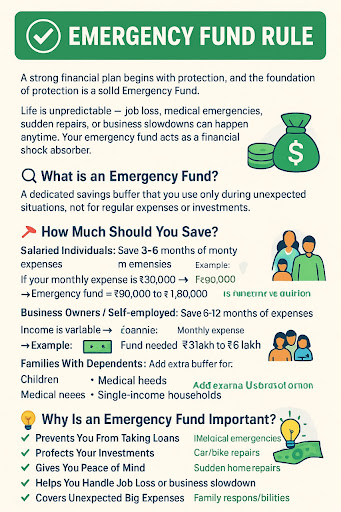
✅ Emergency Fund Rule
A strong financial plan begins with protection, and the foundation of protection is a solid Emergency Fund. Life is unpredictable — job loss, medical emergencies, sudden repairs, or business slowdowns can happen anytime. Your emergency fund acts as a financial shock absorber.
🔍 What is an Emergency Fund?
A dedicated savings buffer that you use only during unexpected situations, not for regular expenses or investments.
📌 How Much Should You Save?
The size of your emergency fund depends on your income stability and family responsibilities:
1️⃣ Salaried Individuals:
Save 3–6 months of your monthly expenses. Example: If your monthly expense is ₹30,000 → Emergency fund = ₹90,000 to ₹1,80,000.
2️⃣ Business Owners / Self-employed:
Save 6–12 months of expenses. Income is variable → you need a bigger cushion. Example: Monthly expense ₹50,000 → Fund needed ₹3 lakh to ₹6 lakh.
3️⃣ Families With Dependents:
Add extra buffer for: • Children • Medical needs • Single-income households
💡 Why Is an Emergency Fund Important?
✔ 1. Prevents You From Taking Loans
Without a buffer, emergencies force you to take credit cards or personal loans at 18–36% interest.
✔ 2. Protects Your Investments
You don’t have to break your SIPs, FD, gold, or stock investments during a crisis.
✔ 3. Gives You Peace of Mind
Financial safety = Mental stability.
✔ 4. Helps You Handle Job Loss or business slowdown
You get time to recover without panic or chaos.
✔ 5. Covers U