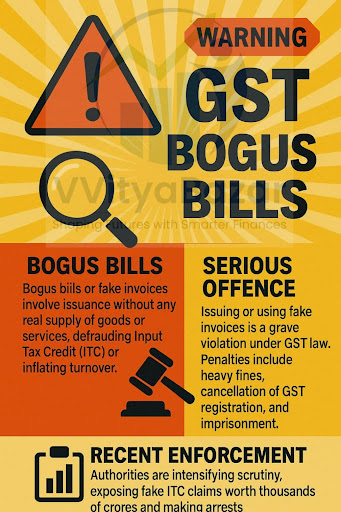
🚨 Professional Insight: GST Bogus Billing – A Growing Concern for Businesses
🔍 What Are Bogus Bills?
“Bogus bills” or “fake invoices” refer to invoices issued without actual supply of goods or services — often used to fraudulently claim Input Tax Credit (ITC) or inflate turnover. This malpractice undermines the integrity of the GST system and invites serious legal consequences.
---
⚠ Why It’s a Serious Offence
Under the GST regime, every invoice must represent a genuine transaction backed by actual supply and payment. Issuing or using fake invoices amounts to tax evasion and fraud under Section 122 & 132 of the CGST Act, 2017, which may lead to:
🔸 Penalty up to 100% of tax evaded
🔸 Cancellation of GST registration
🔸 Prosecution & imprisonment (up to 5 years)
🔸 Blocking or reversal of claimed ITC
🔸 Freezing of bank accounts during investigation
---
📊 Common Red Flags for Bogus Billing
No actual movement of goods (fake e-way bills or transporters)
Mismatch in GSTR-1 vs. GSTR-3B filings
Non-existent or shell suppliers
Same invoice numbers across multiple entities
Unusually high ITC claims compared to turnover
---
🧾 Recent Enforcement Actions
The GST Department and DGGI are actively conducting raids and data analytics-based scrutiny. In the last few months, authorities have uncovered thousands of crore rupees in fake ITC claims across India, leading to multiple arrests and registration cancellations.
---
💡 VVITYABAZAR Expert Advice
Businesse