Skip to content
NOIDA, Uttar Pradesh, 201301

Business hours

Vvityabazar

Monday
10am-7pm
Tuesday
10am-7pm
Wednesday
10am-7pm
Thursday
10am-7pm
Friday
10am-7pm
Saturday
10am-5:30pm
Sunday
Not provided

You can anytime during the day with your query.

8376011028

Latest Posts & Updates

Fresh stories, announcements and offers about Accountant, Insurance agency, Financial Advisor, straight from our business.

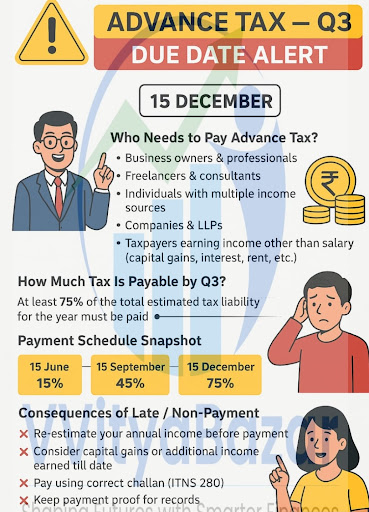
⚠ *ADVANCE TAX – Q3 DUE DATE ALERT* ⚠

📅 *Due Date: 15 December* Advance Tax for *Quarter 3* is mandatory for taxpayers whose total tax liability for the financial year exceeds *₹10,000*. ### 📌 Who Needs to Pay Advance Tax? ✔ Business owners & professionals ✔ Freelancers & consultants ✔ Individuals with multiple income sources ✔ Companies & LLPs ✔ Taxpayers earning income other than salary (capital gains, interest, rent, etc.) ### 💰 How Much Tax Is Payable by Q3? By *15 December, at least **75% of the total estimated tax liability* for the year must be paid. *Payment Schedule Snapshot:* • 15 June – 15% • 15 September – 45% • *15 December – 75%* • 15 March – 100% ### 🚨 Consequences of Late / Non-Payment ❌ Interest under *Section 234B & 234C* ❌ Additional financial burden ❌ Cash flow disruption at year-end ❌ Increased scrutiny during assessment ### ✅ Important Tips ✔ Re-estimate your annual income before payment ✔ Consider capital gains or additional income earned till date ✔ Pay using correct challan (ITNS 280) ✔ Keep payment proof for records 📞 *Need help with Advance Tax calculation or payment?* Get expert assistance and avoid unnecessary interest. Team VVityabazar – Your Trusted Tax Advisors +91 8376011028 #AdvanceTax #AdvanceTaxDueDate #Q3AdvanceTax #IncomeTaxIndia #TaxCompliance #TaxPlanning #CAIndia #BusinessTax #FreelancerTax #DecemberDueDate #TaxAlert
⚠ *ADVANCE TAX – Q3 DUE DATE ALERT* ⚠ post imageRead full post

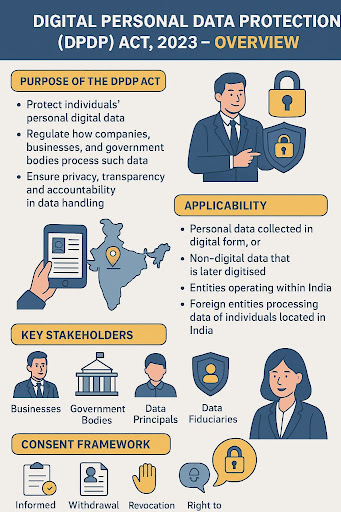
Digital Personal Data Protection (DPDP) Act, 2023 – Overview

1. Purpose of the DPDP Act The DPDP Act aims to: • Protect individuals’ personal digital data • Regulate how companies, businesses, and government bodies process such data • Ensure privacy, transparency, and accountability in data handling 2. Applicability The Act applies to: • Personal data collected in digital form, or • Non-digital data that is later digitised • Entities operating within India • Foreign entities processing data of individuals located in India 3. What is Personal Data? Personal data means any data about an identifiable individual, such as: • Name • Mobile number • Aadhaar/PAN • Email ID • Financial information • IP address or online identifiers 4. Key Stakeholders • Data Principal: The individual whose data is collected • Data Fiduciary: Entity that decides why and how data is processed (company, firm, app, etc.) • Data Processor: Entity processing data on behalf of the Data Fiduciary 5. Consent Framework • Consent must be free, specific, informed, and unambiguous • Consent can be withdrawn at any time • Data can be processed only for lawful purposes 6. Rights of Data Principal Individuals have the right to: • Access their personal data • Correct or erase data • Withdraw consent • Grievance redressal • Nominate another person in case of death/incapacity 7. Obligations of Businesses Businesses must: • Collect data only for lawful purposes • Use data only

Digital Personal Data Protection (DPDP) Act, 2023 – Overview post imageRead full post

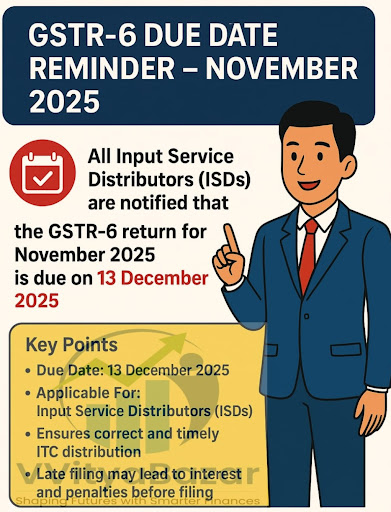
*GSTR-6 Due Date Reminder – November 2025*

All *Input Service Distributors (ISDs)* are notified that the *GSTR-6 return for November 2025 is due on 13 December 2025*. GSTR-6 is a monthly return that contains details of input tax credit (ITC) received, distributed, and any corrections made by the ISD. Timely filing ensures accurate ITC flow to all branches/units. *Key Points:* • *Due Date:* 13 December 2025 • *Applicable For:* Input Service Distributors (ISDs) • Ensures correct and timely *ITC distribution* • Late filing may lead to *interest and penalties* • Reconcile vendor invoices and credit details before filing *Action Required:* Submit your GSTR-6 return on or before the due date to maintain seamless ITC compliance. For professional assistance with GST filings, monthly reconciliations, or compliance reviews, our team is available to support you.

*GSTR-6 Due Date Reminder – November 2025* post imageRead full post

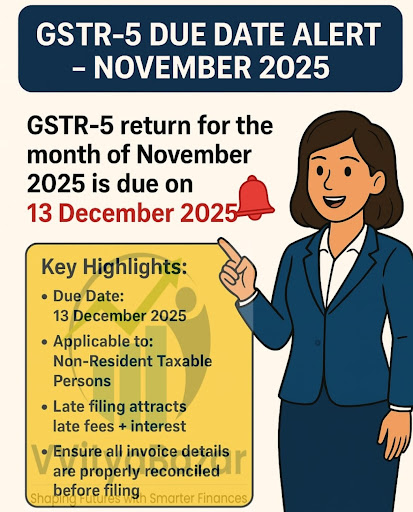
*GSTR-5 Due Date Alert – November 2025*

Non-Resident Taxable Persons (NRTPs) are reminded that the *GSTR-5 return for the month of November 2025 is due on 13 December 2025*. GSTR-5 is a mandatory monthly GST return that captures your outward supplies, inward supplies, and tax liability while operating in India. *Key Highlights:* • Due Date: *13 December 2025* • Applicable to: *Non-Resident Taxable Persons* • Late filing attracts *late fees + interest* • Ensure all invoice details are properly reconciled before filing *Action Required:* File your GSTR-5 on or before the due date to remain fully GST-compliant. For professional assistance with GST filings, monthly reconciliations, or compliance reviews, our team is available to support you.

*GSTR-5 Due Date Alert – November 2025* post imageRead full post

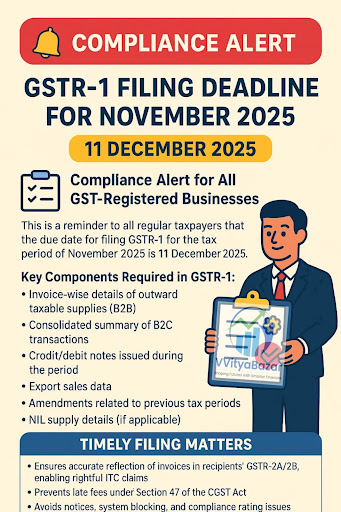
GSTR-1 Filing Deadline for November 2025 – Compliance Alert for All GST-Registered Businesses

This is a reminder to all regular taxpayers that the due date for filing GSTR-1 for the tax period of November 2025 is 11 December 2025. GSTR-1 is a critical monthly compliance requirement under the GST regime and contains the complete summary of outward supplies, including B2B, B2C, exports, and amendments. To maintain seamless compliance and ensure proper Input Tax Credit (ITC) flow for your customers, timely submission of GSTR-1 is essential. Delayed filing not only impacts your own compliance score but also creates reconciliation difficulties for your recipients. Key Components Required in GSTR-1: • Invoice-wise details of outward taxable supplies (B2B) • Consolidated summary of B2C transactions • Credit/debit notes issued during the period • Export sales data • Amendments related to previous tax periods • NIL supply details (if applicable) Why Timely Filing Matters: • Ensures accurate reflection of invoices in recipients’ GSTR-2A/2B, enabling rightful ITC claims • Prevents late fees under Section 47 of the CGST Act • Avoids notices, system blocking, and compliance rating issues • Reduces last-minute portal errors and reconciliation delays • Enables smooth filing of subsequent returns, including GSTR-3B Who Must File? All regular taxpayers under GST, except composition dealers, must file GSTR-1 on a monthly basis unless registered under the QRMP scheme.

GSTR-1 Filing Deadline for November 2025 – Compliance Alert for All GST-Registered Businesses post imageRead full post

⚠ FINAL REMINDER – ONLY 1 DAY LEFT!

ITR Filing Deadline for Companies & Audited Assessees Ends TOMORROW (10 DEC 2025) The extended due date for Income Tax Returns (ITR) for FY 2024-25 (AY 2025-26) is 10 December 2025, and today is 9 December — which means this is the FINAL DAY to complete all pending work. 📌 ITR Filing Due Date: 10 December 2025 (Tomorrow) 🚨 WHY THIS IS EXTREMELY IMPORTANT Missing the deadline may lead to: 1️⃣ Late Filing Fees (₹5,000) Section 234F penalty will apply immediately after 10 December. 2️⃣ Interest & Additional Liability Interest under Sections 234A/234B/234C continues for late filing/late taxes. 3️⃣ Loss of Carry-Forward Benefits If you miss the due date, you cannot carry forward: • Business Losses • Speculation Losses • Capital Losses • Unabsorbed Depreciation 4️⃣ High Probability of Scrutiny Late returns often result in: • IT Notices • AIS/TDS mismatch queries • Assessment scrutiny 5️⃣ Directors’ Compliance Risk Non-filing may be viewed as poor compliance by company management. 📌 LAST-DAY ACTION CHECKLIST ✔ Cross-check books & audit finalization ✔ Reconcile Form 26AS, AIS & Ledger balances ✔ Verify TDS entries & loan confirmations ✔ Complete digital signatures & attachments ✔ File ITR before 11:59 PM, 10 December 2025 ⏳ DON’T WAIT — COMPLETE FILING NOW! For urgent support with ITR filing for companies & audited assessees, Contact Team VVityabazar.

⚠ FINAL REMINDER – ONLY 1 DAY LEFT! post imageRead full post

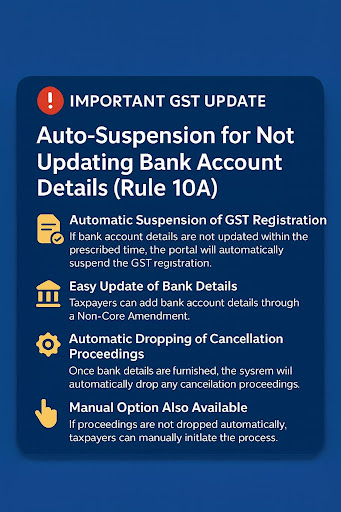
🚨 Important GST Update: Auto-Suspension for Not Updating Bank Account Details (Rule 10A)

GSTN has introduced a new system-based mechanism under Rule 10A for taxpayers who fail to furnish their bank account details within 30 days of GST registration or before filing GSTR-1/IFF — whichever is earlier. Here’s what you must know: 🔸 Automatic Suspension of GST Registration If bank account details are not updated within the prescribed time, the portal will automatically suspend the GST registration. Suspension orders can be viewed under: Services → User Services → View Notices and Orders 🔸 Easy Update of Bank Details Taxpayers can add bank account details through a Non-Core Amendment: Services → Registration → Amendment of Registration 🔸 Automatic Dropping of Cancellation Proceedings Once bank details are furnished, the system will automatically drop any cancellation proceedings. 🔸 Manual Option Also Available If proceedings are not dropped automatically, taxpayers can manually initiate the process through: Services → User Services → View Notices and Orders → Initiate Drop Proceedings 🔸 Exemptions Bank account details not required for OIDAR & NRTP taxpayers. However, OIDAR taxpayers selecting “Representative Appointed in India: Yes” must furnish bank account details. 📌 Action Required: If newly registered, ensure that your bank account details are updated on time to avoid system-based suspension. For GST updates, compliance support & expert guidance, connect with us

🚨 Important GST Update: Auto-Suspension for Not Updating Bank Account Details (Rule 10A) post imageRead full post

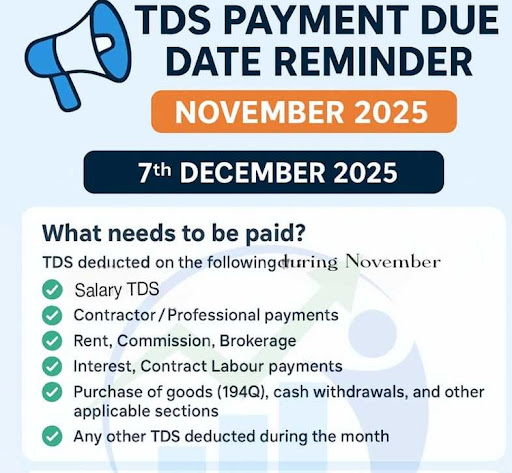
📢 TDS Payment Due Date Reminder – November 2025

⏳ Due Date: 7th December 2025 Timely TDS payment is crucial to avoid interest, penalties, and compliance issues. As we move towards the close of the month, here is a quick compliance reminder for all businesses, professionals, and deductors. 🔍 What needs to be paid? TDS deducted on the following during November 2025 must be deposited by 7th December 2025: ✔ Salary TDS ✔ Contractor/Professional payments ✔ Rent, Commission, Brokerage ✔ Interest, Contract Labour payments ✔ Purchase of goods (194Q), cash withdrawals, and other applicable sections ✔ Any other TDS deducted during the month ❗ Why timely payment is important? Missing the due date may lead to: ⚠ Interest @ 1.5% per month on delayed payment ⚠ Late filing fees under Section 234E ⚠ Disallowance of expenses (up to 30%) ⚠ Avoidable notices and compliance burdens 📝 Quick Checklist for TDS Payment – Nov 2025 🔸 Reconcile books with TDS ledger 🔸 Verify PAN & rate applicability 🔸 Check for lower deduction certificates (if any) 🔸 Finalize TDS challan (ITNS 281) 🔸 Make payment before 7th December 📌 Note: For TDS deducted u/s 194-IA, 194-IB, 194M & 194S, payment is made through Form 26QB / 26QC / 26QD / 26QE with different timelines. 💼 Need assistance with TDS compliance? We help businesses stay 100% compliant with TDS, GST, ROC & Income Tax deadlines. 📞 +91-8376011028 Contact Team Vityabazar For professional compliance support, filings & advisory.

📢 TDS Payment Due Date Reminder – November 2025 post imageRead full post

📌 Retirement Rule — Plan Today, Relax Tomorrow

Retirement may feel far away, but the earlier you plan, the easier life becomes later. One simple formula helps you decide how much to invest in equity vs. safer assets: 🧮 100 – Age Rule (Asset Allocation Formula) This rule tells you how much of your portfolio should be in equity (stocks/mutual funds). 👉 Formula: Equity Allocation = 100 – Your Age Example: If you’re 30 years old: 100 – 30 = 70% in Equity Remaining 30% in Debt, Bonds, Gold. If you’re 45: 100 – 45 = 55% Equity 45% Debt & safer options. 🔍 Why This Rule Works • Equity helps grow wealth faster in early years • Debt stabilises your portfolio as you grow older • Reduces risk as you near retirement • Ensures your retirement fund grows steadily without big losses 🔑 Key Benefits ✔ Builds a balanced retirement portfolio ✔ Gives high growth + low risk strategy ✔ Automatically adjusts with age ✔ Keeps your financial future secure 💡 Real-Life Insight Most people invest randomly without a plan. But those who follow asset allocation rules build bigger and safer retirement wealth—even with the same income. Start early. Stay consistent. Your 60-year-old future self will thank you. 📞 Need help in Retirement Planning? Contact Us – Team VVityabazar We guide you with: ✔ Diversification rule ✔ Emergency fund rule ✔ Personal accident & disability insurance ✔ Retirement strategy ✔ Complete financial planning

📌 Retirement Rule — Plan Today, Relax Tomorrow post imageRead full post

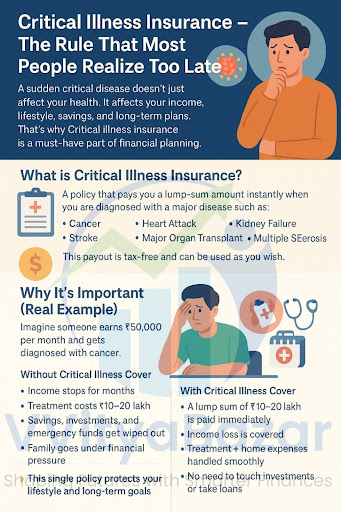
✅ Critical Illness Insurance – The Rule That Most People Realize Too Late

A sudden critical disease doesn’t just affect your health. It affects your income, lifestyle, savings, and long-term plans. That’s why Critical Illness Insurance is a must-have part of financial planning. 🔍 What is Critical Illness Insurance? A policy that pays you a lump-sum amount instantly when you are diagnosed with a major disease such as: • Cancer • Heart Attack • Stroke • Kidney Failure • Major Organ Transplant • Multiple Sclerosis …and many others. This payout is tax-free and can be used as you wish. 💡 Why It’s Important (Real Example) Imagine someone earns ₹50,000 per month and gets diagnosed with cancer. Without Critical Illness Cover: • Income stops for months • Treatment costs ₹10–20 lakh • Savings, investments, and emergency funds get wiped out • Family goes under financial pressure With Critical Illness Cover: • A lump sum of ₹10–20 lakh is paid immediately • Income loss is covered • Treatment + home expenses handled smoothly • No need to touch investments or take loans 👉 This single policy protects your lifestyle and long-term goals. 🛡 Ideal Coverage Amount • Minimum: ₹10 lakh • Best: ₹20–25 lakh, depending on income & dependents 📌 Why You Should Consider It • Covers diseases that are financially draining • Supports you during recovery when income stops • Keeps your investments safe • Gives peace of mind during the toughest period

✅ Critical Illness Insurance – The Rule That Most People Realize Too Late post imageRead full post

Personal Accident & Disability Insurance – The Most Underestimated Protection

We often insure our life and health… But what about our ability to earn? A major accident can: • Stop income temporarily • Cause permanent disability • Increase medical & recovery expenses • Impact your family financially 🔒 Why You Need It This insurance provides money when you: • Can’t work due to an accident • Face partial or total disability • Need treatment & recovery support It replaces income when life becomes unpredictable. 💡 Real Example: A person earning ₹40,000/month meets with an accident and cannot work for 4 months. Lost income = ₹1,60,000. With Personal Accident Insurance, this loss is covered. 👉 Your income is your biggest asset — insure it. 📞 Contact Us – Team VVityabazar to know the right coverage for you +91-8376011028 #PersonalAccidentInsurance #DisabilityInsurance #VVityabazar #IncomeProtection #InsuranceAwareness

Personal Accident & Disability Insurance – The Most Underestimated Protection post imageRead full post

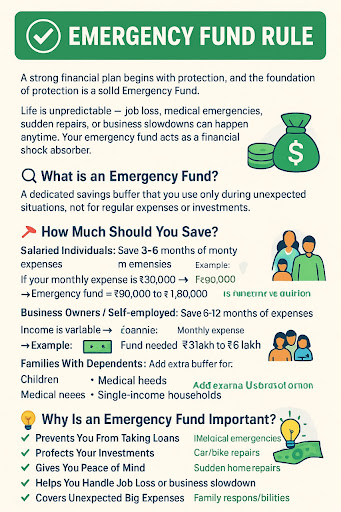
✅ Emergency Fund Rule

A strong financial plan begins with protection, and the foundation of protection is a solid Emergency Fund. Life is unpredictable — job loss, medical emergencies, sudden repairs, or business slowdowns can happen anytime. Your emergency fund acts as a financial shock absorber. 🔍 What is an Emergency Fund? A dedicated savings buffer that you use only during unexpected situations, not for regular expenses or investments. 📌 How Much Should You Save? The size of your emergency fund depends on your income stability and family responsibilities: 1️⃣ Salaried Individuals: Save 3–6 months of your monthly expenses. Example: If your monthly expense is ₹30,000 → Emergency fund = ₹90,000 to ₹1,80,000. 2️⃣ Business Owners / Self-employed: Save 6–12 months of expenses. Income is variable → you need a bigger cushion. Example: Monthly expense ₹50,000 → Fund needed ₹3 lakh to ₹6 lakh. 3️⃣ Families With Dependents: Add extra buffer for: • Children • Medical needs • Single-income households 💡 Why Is an Emergency Fund Important? ✔ 1. Prevents You From Taking Loans Without a buffer, emergencies force you to take credit cards or personal loans at 18–36% interest. ✔ 2. Protects Your Investments You don’t have to break your SIPs, FD, gold, or stock investments during a crisis. ✔ 3. Gives You Peace of Mind Financial safety = Mental stability. ✔ 4. Helps You Handle Job Loss or business slowdown You get time to recover without panic or chaos. ✔ 5. Covers U

✅ Emergency Fund Rule post imageRead full post